Part 1 · Lesson 2 of 9 · 3:15 video
Knowledge and skills: how AI agents use your business knowledge
Give an agent the right knowledge and procedure for a task.
- Lesson files
Course content Lesson 2 of 9
- 01Why AI agents need a harness, and how it works
- 02Knowledge and skills: how AI agents use your business knowledge
- 03Tools, connectors and MCP: how AI agents take action
- 04Three types of AI agents, one brain
- 05The brain in detail: build your first hub with Hubzoid
- 06The Ask agent: give your team an AI agent in chat
- 07The daily report: an AI agent workflow on a schedule
- 08Your own Claude, connected through MCP
- 09Access and telemetry: run AI agents for a whole team
Lesson notes
The ideas from the video, with examples.
Two kinds of files
Knowledge Skill Answers What is true? How do we do this? Example returns-policy.mddaily-report.mdThe model loads it when a question needs the fact a task matches the procedure Changes when a policy or fact changes when the way of working changes Both start with two lines of front matter. The
descriptionis what the model sees on its menu, so say what the file covers or when to use it.A knowledge file
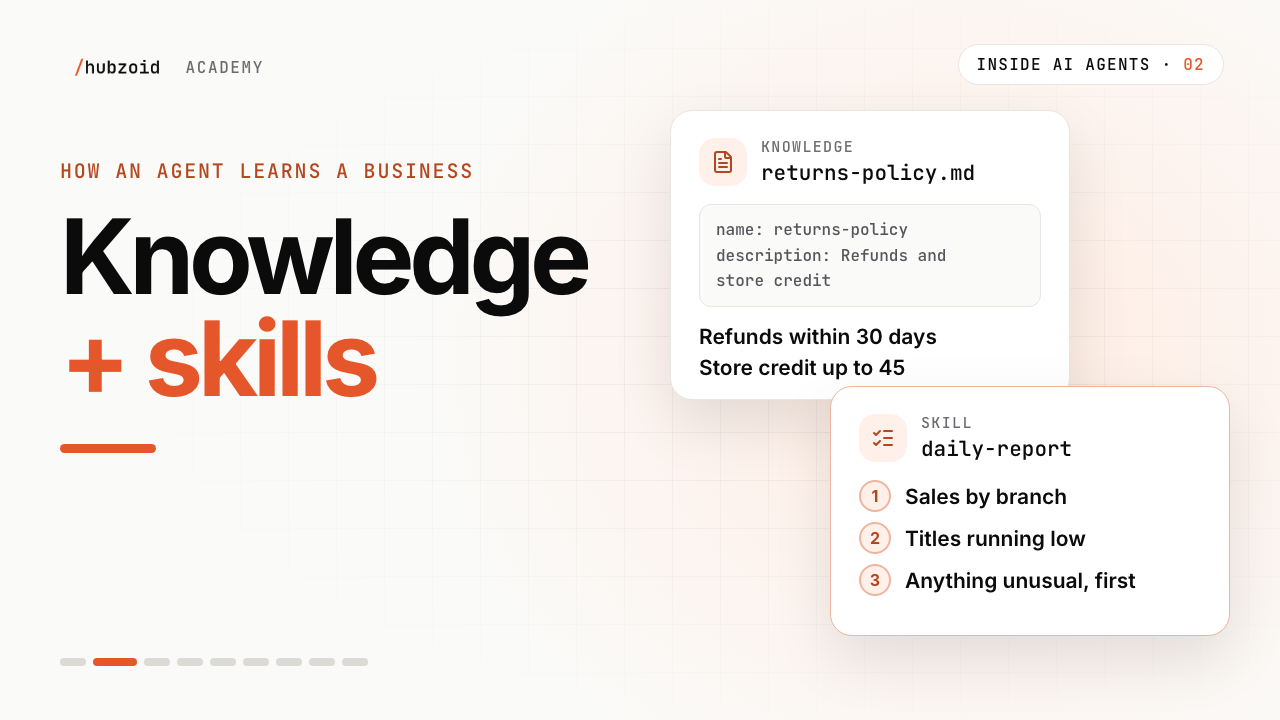
knowledge/returns-policy.md --- name: returns-policy description: Refunds, store credit and time limits. --- # Returns policy - Refunds within 30 days, with a receipt. - Store credit up to 45 days. - Damaged books: replace or refund, at any time. - Gift receipts: store credit only. - Special orders can't be returned unless damaged.A skill file
skills/daily-report.md --- name: daily-report description: Write the morning report for Nora. --- # Daily report 1. Sales by branch, from yesterday, compared with last week. 2. Titles running low: under 5 days of stock. 3. Anything unusual, first: a branch up or down by 20% or more. 4. Keep it to one screen, with the numbers in a table.How the model finds them
The model gets two small tools for each kind of file: one lists the menu, one reads a full file.
Tool Returns list_knowledgeEvery knowledge file as name: descriptionread_knowledge(name)The full text of one knowledge file list_skillsEvery skill as name: descriptionload_skill(name)The steps of one skill Claude and Codex handle skills the same way.
Raw data is searched, not read
Large files, such as a year of sales, live in
raw_data/. The agent searches them withgrep_dataand reads only the lines that match.raw_data/sales.csv (first lines) date,branch,title,copies 2026-09-13,Riverside,Paper Moons,2 2026-09-13,Riverside,Salt and Stars,2 2026-09-13,Riverside,All other titles,202
Exercise
Try it: write your first skill
Pick one task you repeat every week, such as chasing late supplier orders.
Write it as five short steps, one action each.
Add the front matter: a short
nameand adescriptionthat says when to use it.Save it as a Markdown file. The template below is a working example.
---
name: weekly-supplier-follow-up
description: Use on Fridays to chase any supplier order that is late.
---
# Weekly supplier follow-up

1. List open orders older than 7 days.
2. Group them by supplier.
3. Check each against the promised delivery date.
4. Draft one short, polite email per late supplier.
5. Log what you sent, with the date.
In lesson 5, this file goes into a hub's skills/ folder.
If you're stuck
Should this be knowledge or a skill?
What is true: knowledge. How we do it: a skill. A skill can point to a knowledge file, as the daily report does with the KPI definitions.
The agent doesn't use my file
Check the description. "Returns rules" is vague. "Refunds, store credit and time limits" matches real questions. Then check the front matter sits between two --- lines at the top.
My document is very long
Split it by topic, one clear description each. Growing tables and logs go in raw_data/.
I changed a file. When does the agent see it?
Knowledge edits apply on the next question. Skills load when the hub starts, so restart it after changing one.
Still stuck? Run hubzoid doctor on your hub, then search GitHub issues (opens in a new tab) with your version and the full error. Setting it up for a team? Request a demo.
Go deeper
- Hub file referenceEvery file a hub can hold, and its format.
- Design an agentDecide what goes in instructions, knowledge and skills.
- Claude Agent Skills (opens in a new tab)How Claude loads skills on demand.
- Codex skills (opens in a new tab)The same pattern in Codex.
Transcript and what the video shows
Intro
Welcome back to Inside AI Agents. Last time, the harness, the loop that lets a model do real work. This time, what the model reads while it works.
The shop's know-how
Wren and Page has sold books for twenty years. Everything the shop knows lives in three places. A binder behind the counter. A shared drive. And people's heads.
The returns policy. What sell-through means. Which publisher gives which discount. How Maya checks an invoice. How Nora likes the morning numbers.
A model knows none of this. It knows books in general, not this shop.
You could paste it all into every request. But that's hundreds of pages, sent every single time. It's slow, it costs more, and the model gets less precise when it has to wade through everything.
Two kinds of files
So the shop's know-how is written down as two kinds of files.
Knowledge is what's true. The returns policy. What the numbers mean. The terms agreed with each publisher. Each document gets a name, and one line saying what it covers.
Skills are how the work is done. Check an invoice. Write the daily report. Each skill is a short procedure, step by step, with one line saying when to use it.
A menu, not the whole binder
Remember the menu from last time? This is where it comes from. The harness sends the model only the names and descriptions. A few lines, instead of hundreds of pages.
Knowledge, when it's needed
Now Sam, who runs the Riverside branch, has a question. A customer wants to return a book they bought five weeks ago. Can they?
The model scans the menu, and spots the returns policy. It asks to read it, and the harness hands back just that one document. Refunds within thirty days. Store credit up to sixty.
So the answer is store credit, and the model can say exactly where that came from.
Skills, when they're needed
Later, Nora asks for the morning report. That matches a skill. Write the daily report. The model loads it, and follows the steps. Sales by branch. Titles running low. Anything unusual, first. The same way every time, whoever asks.
Too big to read
Some things are too big to read at all. A year of sales. Every past invoice. Those stay as raw data. The model searches them, and reads only what matches.
And because it's all just files, the team keeps it current. Change the returns policy once, and every answer uses the new version.
Knowledge and skills
So that's how an agent learns a business. Knowledge says what is true. A skill says how to do something. And the harness loads each one only when it's needed.
Claude and Codex handle skills the same way. Names first, and the full steps only when they're needed.
Knowledge says what's true. Skills say how.
Try it and next
Try this. Pick one task you repeat every week. Write it down in five steps. Give it a name, and one line saying when to use it. That's a skill.
Next time, the brain gets its hands. Tools and connectors, and how an agent reaches your systems.
What the video shows
- Knowledge is a reference document. A skill is a named procedure with steps.
- The menu gives the model short descriptions first. The full file is loaded only when needed.
 Up next: lesson 3, 3:23Tools, connectors and MCP: how AI agents take action